An interview with Noelle Hardy, who plays part of the ghost chorus in Hungry Ghosts.
How do you choose the roles you play, and why did you choose to participate in this project?
Why Hungry Ghosts? M.E.H. Lewis - Working with on something by her is almost always guaranteed to be not only interesting but fun. I look forward to any opportunity I have to jump in on a project involving her. Choosing roles is a lot in timing and luck. I try to hold out for roles that are a challenge; characters that I don't agree with or that I find lots of fault with. The process of understand how they tick and what compels them make those "bad"or "imprudent" choices helps me learn about life, myself, acting, and hopefully that struggle teaches me a bit of humility. When I cannot get that sort of "meat" in a role I go for directors, writers, and colleagues that I enjoy working with.
Can you describe the part you play in Hungry Ghosts?
I play one of the ensemble that surrounds the chief protagonists in the play, Alice and Isabelle. As the ensemble we contribute to the tapestry of foreign flavor and life. We help support, agitate, and in some cases propel their journeys. We use vocal and physicality to help create the mood needed as Alice and Isabelle struggle with the past or the lack of a past.
What was most challenging and/or rewarding for you about that part?
It's always challenging to be part of an ensemble. You walk a tight-rope to stay engaged, especially when you are not being featured in a scene. We run the risk of stealing focus, or totally disengaging and seeming to space out until it's time to talk. Margaret has done a wonderful job of stacking the dialogue in a way that we don't get to space out for too long before we have to chime in behind one of the leads to help a certain emotion or idea resonate. We are always on the stage too so there really is no opportunity relax or get a drink or anything and that can be a bit difficult..
What is your process of preparing for a role?
It's different every time. If I am doing what I call 'heavy lifting" I use photos, and create a sound track that I listen to on the way to the theatre or anytime I'm off stage. So that I stay on the verge of the emotional state of the character. In this particular play I have spent a lot of time creatively riffing with the other talented actors to create the entity of the ensemble that is comfortable going with a choice and experimenting with every riff that is presented. There really is a wonderful trust that has formed and I hope to be so lucky to work with this crew again.
How was that process different in the compressed timeline of LeapFest?
Pain! No. Kidding. It was a challenge because of the time lapses between rehearsals and the demands of the play to have a very strong ensemble, multiple locations and much physical and vocal experimentation. I'm afraid all the layers we would have liked to add were impossible to get, but that type of thing can really take years of a run to fully developer. The brush strokes we do have are extremely beautiful and affecting. But now I"m bragging.
Hungry Ghosts is an intensively ensemble-driven piece. Can you talk about the experience of participating in that?
It has been really incredible. I'm used to being a bit isolated in my acting and focusing on my process totally unless I am directly talking to an actor in a scene. I find such a strong connection to this particular cast that a constant and inexhaustible level of energy flows from and into me. It's an extraordinary sensation to be on stage and loose your identity to a much larger thing. It could be very unnerving with a cast that I don't love and trust to well.
For you, what is this play about?
For me this play is about truth, maturation and resolution. Finding truth is one thing. Accepting truth when you find it is another thing entirely. Alice like a child is unwilling to accept that she cannot find every missing piece, Isabelle is equally unwilling to acknowledge her personal history, both of these blocks are blinding these women to the truth and is staring them in the face so to speak. The journey they have together causes them to mature and see the truths face to face and then resolution follows.
Any other thoughts?
Ya'll come back now. Y'hear?
You can see the final performance of Hungry Ghosts tonight, May 29th at 7:30pm.
Thursday, May 28, 2009

Keeping Us All in Line
Now that LeapFest is over, a few words from Christopher Thompson, the heroic soul who kept it all together and moving forward.
You're the LeapFest stage manager. Many people may not know exactly what a stage manager does, so could you give us a quick job description?
Basically, a stage manager works closely with all of the members of the production team; directors, producers, actors, designers, and anyone else involved with the show. One of their main jobs is to organize all of the information passed around from all of the groups and make sure that the individuals that the information is meant for receive it. I also run the rehearsals, if a production requires it (because of LeapFest’s unique nature, I was not needed at the rehearsals and was brought in for tech). Tech is an extremely important time for a stage manager, as it is the culmination of all the designers work. The stage manager takes detailed notes pertaining to the Light and Sound Cues, specific visual cues, and any other technical aspects that pertain tithe performance (such as projectors in two of the LeapFest shows). Wit hall of the information gathered over the tech days, the stage manager gathers it all in his script book, and should be ready for the performances. In some cases, it is required of a stage manager to run the cues that he would normally be calling. With LeapFest, the light,sound, and projection cues are all run from the booth (in the Upper Stage Left Corner of the space), by myself. Sometimes there are other operators on the light and sound boards, and in those cases, the stage manager would do what is known as “calling” a show. This means that they would call the cue out loud so that the other operators know when to run them. In a nutshell, those are the basics of stage management. There is also the setting up before anyone arrives, making sure everyone has everything that they need, and shutting down/closing up the space after each use.
Tell us a little bit about your background and what drew you to stage management.
When I was in high school, I spent the majority of my time on the stage.I was fortunate enough to be in a class that was very theatrically inclined and during my sophomore year, we were able to start an All-School Musical each year. I performed roles which I will never have a chance to play again, like Adam/Noah from Children of Eden, Jean Valjean from Les Miserables, and the Beast from Beauty and the Beast. Although I love performing on stage (both singing and acting), I was drawn into the backstage aspects during my final year of high school. I stage managed a musical called Thoroughly Modern Millie and was in love ever since. I have always believed that I was a very organized person (sometimes to the extreme of OCD), and stage management allowed me to use those skills along with my ability to interact with people well. When I arrived at Loyola, I continued acting, but took up stage management as well and have been going at it ever since.
LeapFest consists of five different plays performed over three weeks. That's a daunting schedule. What drew you to this project, and what's the greatest challenge?
I first heard of Stage Left’s need for a stage manager through an email and met with Artistic Director Drew Martin soon after responding. After reading up on both Stage Left and LeapFest, I gained an incredible respect for the work that everyone puts into bringing these plays to the next level. Whenever you see a show, or work on an older piece, there is much more available for reference. Chances are, the lines are not going to be changed halfway through the rehearsal period, as I’m fairly sure that Eugene O’Neill or Tennessee Williams would not appreciate changes to the text. And even if there are changes, they will most likely be small, perhaps a word or phrase change. LeapFest offers the working space to improve a work in progress, making it performance ready. I had never worked on a new play proj challenge, although I wouldn’t call it a challenge is the shortness of my involvement with the shows. In the usual situation, the stage manager is in the production process from the very beginning, and in LeapFest, I was present starting at tech. This creates no major problems, but the connections that I would have usually made with a cast, production team,and director is cut short in this festival. Although I have enjoyed every moment working with everyone involved, it has been a short process.
From your perspective, how would you describe LeapFest?
Well, taking a little from the above section, LeapFest is exactly how it sounds, a festival dedicated to giving new plays that leap into the next step towards becoming a full production. One of the greatest things that I believe LeapFest offers is the Talk-Back session at the end of every show. Audience members give their perspective of the play, including what they did not understand, what could be clearer, etc. Through this,playwrights are able to see how their play affects a wide range of individuals, giving them a greater insight into their play. LeapFest offers the playwrights this unique chance.
What's next for you?
After I leave Stage Left at the end of May, I will be packing my bags for the sunny beaches of South Caroline (Myrtle Beach) and vacationing for a week and a half with my family. Then it will be back to the good ol' city of Chicago where I will be taking summer classes at Loyola University Chicago. This will only last through a portion of August, however, as I will be studying abroad in London, England for the fall semester of this year. If we really want to jump ahead of that, the road that is laid before me leads to the LSAT and law school.
You're the LeapFest stage manager. Many people may not know exactly what a stage manager does, so could you give us a quick job description?
Basically, a stage manager works closely with all of the members of the production team; directors, producers, actors, designers, and anyone else involved with the show. One of their main jobs is to organize all of the information passed around from all of the groups and make sure that the individuals that the information is meant for receive it. I also run the rehearsals, if a production requires it (because of LeapFest’s unique nature, I was not needed at the rehearsals and was brought in for tech). Tech is an extremely important time for a stage manager, as it is the culmination of all the designers work. The stage manager takes detailed notes pertaining to the Light and Sound Cues, specific visual cues, and any other technical aspects that pertain tithe performance (such as projectors in two of the LeapFest shows). Wit hall of the information gathered over the tech days, the stage manager gathers it all in his script book, and should be ready for the performances. In some cases, it is required of a stage manager to run the cues that he would normally be calling. With LeapFest, the light,sound, and projection cues are all run from the booth (in the Upper Stage Left Corner of the space), by myself. Sometimes there are other operators on the light and sound boards, and in those cases, the stage manager would do what is known as “calling” a show. This means that they would call the cue out loud so that the other operators know when to run them. In a nutshell, those are the basics of stage management. There is also the setting up before anyone arrives, making sure everyone has everything that they need, and shutting down/closing up the space after each use.
Tell us a little bit about your background and what drew you to stage management.
When I was in high school, I spent the majority of my time on the stage.I was fortunate enough to be in a class that was very theatrically inclined and during my sophomore year, we were able to start an All-School Musical each year. I performed roles which I will never have a chance to play again, like Adam/Noah from Children of Eden, Jean Valjean from Les Miserables, and the Beast from Beauty and the Beast. Although I love performing on stage (both singing and acting), I was drawn into the backstage aspects during my final year of high school. I stage managed a musical called Thoroughly Modern Millie and was in love ever since. I have always believed that I was a very organized person (sometimes to the extreme of OCD), and stage management allowed me to use those skills along with my ability to interact with people well. When I arrived at Loyola, I continued acting, but took up stage management as well and have been going at it ever since.
LeapFest consists of five different plays performed over three weeks. That's a daunting schedule. What drew you to this project, and what's the greatest challenge?
I first heard of Stage Left’s need for a stage manager through an email and met with Artistic Director Drew Martin soon after responding. After reading up on both Stage Left and LeapFest, I gained an incredible respect for the work that everyone puts into bringing these plays to the next level. Whenever you see a show, or work on an older piece, there is much more available for reference. Chances are, the lines are not going to be changed halfway through the rehearsal period, as I’m fairly sure that Eugene O’Neill or Tennessee Williams would not appreciate changes to the text. And even if there are changes, they will most likely be small, perhaps a word or phrase change. LeapFest offers the working space to improve a work in progress, making it performance ready. I had never worked on a new play proj challenge, although I wouldn’t call it a challenge is the shortness of my involvement with the shows. In the usual situation, the stage manager is in the production process from the very beginning, and in LeapFest, I was present starting at tech. This creates no major problems, but the connections that I would have usually made with a cast, production team,and director is cut short in this festival. Although I have enjoyed every moment working with everyone involved, it has been a short process.
From your perspective, how would you describe LeapFest?
Well, taking a little from the above section, LeapFest is exactly how it sounds, a festival dedicated to giving new plays that leap into the next step towards becoming a full production. One of the greatest things that I believe LeapFest offers is the Talk-Back session at the end of every show. Audience members give their perspective of the play, including what they did not understand, what could be clearer, etc. Through this,playwrights are able to see how their play affects a wide range of individuals, giving them a greater insight into their play. LeapFest offers the playwrights this unique chance.
What's next for you?
After I leave Stage Left at the end of May, I will be packing my bags for the sunny beaches of South Caroline (Myrtle Beach) and vacationing for a week and a half with my family. Then it will be back to the good ol' city of Chicago where I will be taking summer classes at Loyola University Chicago. This will only last through a portion of August, however, as I will be studying abroad in London, England for the fall semester of this year. If we really want to jump ahead of that, the road that is laid before me leads to the LSAT and law school.
What is a Hero?
An interview with David Alan Moore, Stage Left's Artistic Director, and author of Safe.

Of course, the “inciting event” in the play, the death of the man trapped in the burning building, is connected to an actual event that none of us can forget: the attacks of 9/11. A few years ago, many of the recordings of 911 calls made to emergency-services dispatchers by people trapped in the World Trade Center towers were released to the public. Out of what was probably morbid curiosity, I listened to a few of them. One recording, in particular, struck me with a wallop: a four-minute -- conversation? dialogue? scream? -- between a man and an operator that ended only when the tower he was in collapsed around him. Rumble. Click. Dial tone. Horror.
Of course, from there I began musing about the illusion of security in an unpredictable world, the nature of loss and, perhaps more obscurely (at least in the script), the question of “heroism.”
What is a hero? We hear about big, made-for-the-media acts of heroism every day, and such stories clearly fill a personal and societal need. But I often think that, for any sentient, conscious and self-aware being, merely getting through the day -- however you manage to get through the day -- is the biggest act of heroism of all. Knowing -- and not knowing -- what’s out there, yet finding a way to keep going, to have hope? Pretty impressive, if you ask me.

Please describe your LeapFest play, Safe, and tell us a little bit about the inspiration for it.
At a recent appearance in New York City, the writer Edna O’Brien was asked where she got the ideas for her stories. She said they’relike egg nog: she doesn’t know where they come from or what they’re made of. (Note: I was pleased that she didn’t compare her ideas to sausage, partly because everyone uses that analogy and partly because I prefer sausage over egg nog!)
At a recent appearance in New York City, the writer Edna O’Brien was asked where she got the ideas for her stories. She said they’relike egg nog: she doesn’t know where they come from or what they’re made of. (Note: I was pleased that she didn’t compare her ideas to sausage, partly because everyone uses that analogy and partly because I prefer sausage over egg nog!)
Of course, the “inciting event” in the play, the death of the man trapped in the burning building, is connected to an actual event that none of us can forget: the attacks of 9/11. A few years ago, many of the recordings of 911 calls made to emergency-services dispatchers by people trapped in the World Trade Center towers were released to the public. Out of what was probably morbid curiosity, I listened to a few of them. One recording, in particular, struck me with a wallop: a four-minute -- conversation? dialogue? scream? -- between a man and an operator that ended only when the tower he was in collapsed around him. Rumble. Click. Dial tone. Horror.
I realized that, in all the talk about the “heroes” of 9/11, very little mention had been made of the hundreds of emergency-services dispatchers who’d fielded thousands of calls from terrified victims, bystanders, and fire and police personnel. Who were these people? How did they cope with a tragedy of such monumental scale -- and how do they and their peers around the country cope with the less-massive but potentially, equally tragic calls they receive every day?
Of course, from there I began musing about the illusion of security in an unpredictable world, the nature of loss and, perhaps more obscurely (at least in the script), the question of “heroism.”
What is a hero? We hear about big, made-for-the-media acts of heroism every day, and such stories clearly fill a personal and societal need. But I often think that, for any sentient, conscious and self-aware being, merely getting through the day -- however you manage to get through the day -- is the biggest act of heroism of all. Knowing -- and not knowing -- what’s out there, yet finding a way to keep going, to have hope? Pretty impressive, if you ask me.
How has the play evolved during your participation in LeapFest?
To be honest (see my answer to the fourth question, below), this time around the play as written hasn’t evolved that much during the LeapFest process. That’s mostly circumstantial; past LeapFest plays (In Times of War and The Day of Knowledge) experienced major growth spurts during the rehearsals and between performances.
To be honest (see my answer to the fourth question, below), this time around the play as written hasn’t evolved that much during the LeapFest process. That’s mostly circumstantial; past LeapFest plays (In Times of War and The Day of Knowledge) experienced major growth spurts during the rehearsals and between performances.
I wish that weren’t the case this time -- and the cast, the crew and the director (Scott Bishop) of Safe are awesome, so this should in no way be seen as a knock against them or their contributions. They have leapt into the process with both feet -- their entire bodies, really.
However, at my end of the teeter-totter, most of the work during this year’s fest has been happening between my ears. Answering questions from the cast and director, seeing the show play out in front of me, experiencing it as part of an audience -- all of these things have helped open my eyes and ears to many of the strengths and flaws in the current draft, and will help inform the next rewrite. So at least one goal of LeapFest (helping the playwright craft the play) is definitely being fulfilled. And I think audiences are enjoying the show in its current iteration, too. It’s good to know that even a workshop production can have an effect on an audience, can be a satisfying theatrical experience.
However, at my end of the teeter-totter, most of the work during this year’s fest has been happening between my ears. Answering questions from the cast and director, seeing the show play out in front of me, experiencing it as part of an audience -- all of these things have helped open my eyes and ears to many of the strengths and flaws in the current draft, and will help inform the next rewrite. So at least one goal of LeapFest (helping the playwright craft the play) is definitely being fulfilled. And I think audiences are enjoying the show in its current iteration, too. It’s good to know that even a workshop production can have an effect on an audience, can be a satisfying theatrical experience.
What is your personal writing process, and what are the benefits or pitfalls of a workshop production for you?
I am very definitely not one of those playwrights who sits down to write for a predetermined amount of time or pages per day. Godspeed to those who can and do, especially if that process works for them. I’ve tried it, and it generally produces more guilt (when I fail to stick to a schedule) than good writing.
I am very definitely not one of those playwrights who sits down to write for a predetermined amount of time or pages per day. Godspeed to those who can and do, especially if that process works for them. I’ve tried it, and it generally produces more guilt (when I fail to stick to a schedule) than good writing.
My own process is a bit like baking bread. I rarely even begin writing a scene or a play until after the ideas, the characters, the action and the dialogue have been churning in my head for a good while -- months, sometimes. Like bread dough, I throw all the ingredients in, let the mess ferment and rise for a while, punch it back down, and repeat the process a few times, all in my head. Only after the loaf or play or scene has taken solid shape do I then commit it to paper (or computer). At that point, it’s like dictation -- the amount I get written at any given point is dependent upon how fast I can type.
That doesn’t mean that I only ever write final drafts. Nor does it mean that I don’t do experiments on paper. But what’s particularly great about the workshop process and a workshop production is that a play, meant to be staged, best reveals itself when it’s on its feet, when it’s in the hands of actors and directors and designers for their interpretations and explorations. Not all of my loaves are perfect when they come out of the oven -- some are like bricks, some are all air!
Do I write this way because it’s my nature, or do I write this way out of necessity? Possibly the latter: as a freelance writer by trade for the better part of 15 years, I spend much of every day parked in front of my computer, writing. Because my clients don’t have the time or the budget for me to write multiple drafts, my first drafts (for my clients) need to be of third-draft quality. So, in contrast to what I said before, I guess I do write every day. It’s just that what I write generally doesn’t make an appearance on the page until it’s been written and re-written in my head several times.
You are also Stage Left's Interim Co-Artistic Director, so you are wearing many hats. How has that impacted your involvement as a writer, and have you learned anything valuable through seeing the process from that perspective?
On the downside, being Interim Co-Artistic Director has had a definite, negative impact on the amount of time I have had available to write, both of the “in my head” sort and the “on paper” sort, as described above. Helping run a theater and managing an ensemble of two dozen very diverse artists is a huge job for anyone (or two), especially when it isn’t offset by a concomitant reduction in other professional and personal commitments. Oh, the deadlines I’ve missed! The friends I’ve ignored! Get out the violins...!
(And kudos to Laura Blegen and Drew Martin for helping me keep at least a modicum of balance.)
On the downside, being Interim Co-Artistic Director has had a definite, negative impact on the amount of time I have had available to write, both of the “in my head” sort and the “on paper” sort, as described above. Helping run a theater and managing an ensemble of two dozen very diverse artists is a huge job for anyone (or two), especially when it isn’t offset by a concomitant reduction in other professional and personal commitments. Oh, the deadlines I’ve missed! The friends I’ve ignored! Get out the violins...!
(And kudos to Laura Blegen and Drew Martin for helping me keep at least a modicum of balance.)
On the upside, you learn a heck of a lot about the theater -- the industry, the business, the artists, the audiences, the collaborations, the conflicts of interest, and the joys of creating art on a larger scale -- when you’re in the thick of producing one season and planning for the next for an entire company.
A separate but related thought: I have always been of the opinion that art comes first, practicality second. That is part and parcel of my broader worldview and is unlikely to change (much to the chagrin of certain people close to me who feel I’m more grasshopper than ant). So it has been an eye-opening experience to see the other side of this chicken-or-egg question: how do you sustain artists and the process of creating and sharing art, especially in an economy and an era that are so anti-art? My own response, at the end of this year, is to refocus on my writing, because that’s what sustains me.
For whatever reason, I am driven to write. I am not driven to be an impresario or someone with a title after his name. Nor am I driven to fix what I see as some pretty major flaws in the way we produce theater in this country. I’ll happily share my opinions (elsewhere, if asked!) and will applaud the individual with the the focus and the energy to right the wrongs of the industry -- but I am not that person, I’ve discovered.
Most of my own energy will go into my writing because I cannot help myself. Further, I’m a firm believer that even if a sculpture is locked in a room, it is still a sculpture. A tree falling in a forest, unobserved, still makes a sound. Whether it’s a piece of furniture I’ve designed and built with my own hands, or a play I’ve written, that’s what excites me: the created thing itself. There it is. See?

Of course, I’m also drawn to the Buddhist idea of impermanence. I wear a bracelet of tiny skulls around my wrist to remind me that everything changes. Likewise, when it comes to my writing, that play, that thing I created, I also don’t worry too much about its future. Yes, what happens to it afterward is my concern, but it’s not my worry. Like a mandala made of colored sand, it’s beautiful -- and then along comes the wind. Will thousands of people see my play? Lovely! Will it be appreciated by an audience of one? Equally lovely -- and equally out of (and in) my control.

Of course, I’m also drawn to the Buddhist idea of impermanence. I wear a bracelet of tiny skulls around my wrist to remind me that everything changes. Likewise, when it comes to my writing, that play, that thing I created, I also don’t worry too much about its future. Yes, what happens to it afterward is my concern, but it’s not my worry. Like a mandala made of colored sand, it’s beautiful -- and then along comes the wind. Will thousands of people see my play? Lovely! Will it be appreciated by an audience of one? Equally lovely -- and equally out of (and in) my control.
You can see the final LeapFest performance of Safe today, May 30th, at 7:30pm.
Antigone & Torture
An interview with Jessica Cluess, author of Anna is Saved.
Please tell us a little bit about yourself and your writing
I grew up in Los Angeles, but I had to leave because it just wasn’t cold enough. I went to Northwestern University, really enjoyed it, and stayed on in Chicago. As for my writing, I’d say it comes out of performance. I’ve had substantially more professional training as an actor than as a writer, so how a sentence feels in a person’s mouth, whether it flows or not, is always a priority for me. I’ve performed my own work and enjoy it. In high school I was something of a monologist and I did a lot of comedic work, which made it strange when I came to college and just started doing drama after drama. I suppose it’s all changed the way I write; I like a balance of comedy and drama in my stories.
Describe your play Anna is Saved and the inspiration for it.
Anna is Saved came out of my feelings about the play ‘Antigone.’ I’ve had a lot of experience with that play. I studied it in class, and I was in a very avant garde production of it. (The central motif was a can of Coke.) Everybody was going on about what a hero Antigone was, and I just couldn’t get over the fact that she scorned her sister, her last remaining relative, and told her to get lost because she needed to be a glorious martyr. Some will beg to differ with my interpretation, but I think she’s more complex and unlikable than some may believe. So there was that, and then I thought about an experience in high school where some girls were going to a rally at UCLA to protest the war. When I talked to them about it, they revealed that they were doing it because it was an excuse to cut class and dress up in their parents’ vintage hippie clothes, and sort of ‘live out the 60s.’ So I had a classic figure, someone with whom I wanted to experiment, and the image of youth protesting and shouting, not because they want to change the world, but because they want to be important or get noticed. Then you throw in torture policies in the Bush years, and I was all set.
What is your writing process like?
My writing process changes all the time. Sometimes it’s the classic ‘go to cafes with a notebook and work’ thing, sometimes I just sit down and outline on my computer, and sometimes I actually grab my tape recorder and sort of act it out, try out dialogue, see if it feels right in my mouth. The tape recorder part can kind of worry the people who live with me. There can be a little shouting with that one. I try to do that one when no one’s home to be bothered. Otherwise it just looks insane.
How has your play changed through its involvement in LeapFest?
By the time the play got to Leapfest, it’d been through three workshop processes. I wrote it in a class my senior year of college, a student group performed it as part of a new play festival, and then Stage Left took it for their Down Stage Left workshop program last winter. So when it got here, its bones were already pretty clearly built. Because the basic foundation was laid, (and because, at an hour, it’s pretty damn short), we were able to delve deeper into character; why do they do what they do, what do they really want, if they have a change of heart does it make sense. The character of Baumer, the General’s right hand man, got a complete overhaul. He started off as this fat, slovenly fifty something who had no real experience in anything, and he turned into this rough and ready young man who was an accomplished soldier. It made the play so much better. On top of that, we changed dialogue, added and subtracted monologues, and just tightened as much as we could. What I love about the Leapfest process is how it is such a bridge between a reading and a production; Anna is Saved is, in many senses, a very physical play, and actually seeing the violence and physical comedy makes SUCH a difference to an audience. It makes it funnier, and also more terrifying.
Writing comedy is notoriously difficult. Do you find the workshop process more or less valuable in working on comedy?
I think whether or not comedy works onstage comes right down to the acting. Granted, writing and directing are a huge factor, but if the actors don’t get it, no one else will. I knew the workshop process would only be helpful if the actors got the comedy, and luckily they did. The play has five actors, and they all had different levels of comedic experience, but they all delivered. The workshop was lots of fun because the actors all brought their own ideas and funny moments to the table, and a lot of it worked and stayed in. Plus, ‘Anna is Saved’ isn’t exactly a riotous farce from start to finish. It starts off very funny, and then slowly it becomes not…funny…at all. The actors were very adept at handling the transition. They’re pretty fantastic all around.
What's next for you?
I’m currently working on a one-woman show called ‘What If He Dies, And We’re Still In Texas?’ detailing my life on the road in a traveling children’s theatre troupe, and I’ve got a few other things I’m working on. But I’m twenty-four. I’ll take whatever you’ve got!
Please tell us a little bit about yourself and your writing

I grew up
 in Los Angeles, but I had to leave because it just wasn’t cold enough. I went to Northwestern University, really enjoyed it, and stayed on in Chicago. As for my writing, I’d say it comes out of performance. I’ve had substantially more professional training as an actor than as a writer, so how a sentence feels in a person’s mouth, whether it flows or not, is always a priority for me. I’ve performed my own work and enjoy it. In high school I was something of a monologist and I did a lot of comedic work, which made it strange when I came to college and just started doing drama after drama. I suppose it’s all changed the way I write; I like a balance of comedy and drama in my stories.
Describe your play Anna is Saved and the inspiration for it.
Anna is Saved came out of my feelings about the play ‘Antigone.’ I’ve had a lot of experience with that play. I studied it in class, and I was in a very avant garde production of it. (The central motif was a can of Coke.) Everybody was going on about what a hero Antigone was, and I just couldn’t get over the fact that she scorned her sister, her last remaining relative, and told her to get lost because she needed to be a glorious martyr. Some will beg to differ with my interpretation, but I think she’s more complex and unlikable than some may believe. So there was that, and then I thought about an experience in high school where some girls were going to a rally at UCLA to protest the war. When I talked to them about it, they revealed that they were doing it because it was an excuse to cut class and dress up in their parents’ vintage hippie clothes, and sort of ‘live out the 60s.’ So I had a classic figure, someone with whom I wanted to experiment, and the image of youth protesting and shouting, not because they want to change the world, but because they want to be important or get noticed. Then you throw in torture policies in the Bush years, and I was all set.
What is your writing process like?
My writing process changes all the time. Sometimes it’s the classic ‘go to cafes with a notebook and work’ thing, sometimes I just sit down and outline on my computer, and sometimes I actually grab my tape recorder and sort of act it out, try out dialogue, see if it feels right in my mouth. The tape recorder part can kind of worry the people who live with me. There can be a little shouting with that one. I try to do that one when no one’s home to be bothered. Otherwise it just looks insane.
How has your play changed through its involvement in LeapFest?
By the time the play got to Leapfest, it’d been through three workshop processes. I wrote it in a class my senior year of college, a student group performed it as part of a new play festival, and then Stage Left took it for their Down Stage Left workshop program last winter. So when it got here, its bones were already pretty clearly built. Because the basic foundation was laid, (and because, at an hour, it’s pretty damn short), we were able to delve deeper into character; why do they do what they do, what do they really want, if they have a change of heart does it make sense. The character of Baumer, the General’s right hand man, got a complete overhaul. He started off as this fat, slovenly fifty something who had no real experience in anything, and he turned into this rough and ready young man who was an accomplished soldier. It made the play so much better. On top of that, we changed dialogue, added and subtracted monologues, and just tightened as much as we could. What I love about the Leapfest process is how it is such a bridge between a reading and a production; Anna is Saved is, in many senses, a very physical play, and actually seeing the violence and physical comedy makes SUCH a difference to an audience. It makes it funnier, and also more terrifying.
Writing comedy is notoriously difficult. Do you find the workshop process more or less valuable in working on comedy?
I think whether or not comedy works onstage comes right down to the acting. Granted, writing and directing are a huge factor, but if the actors don’t get it, no one else will. I knew the workshop process would only be helpful if the actors got the comedy, and luckily they did. The play has five actors, and they all had different levels of comedic experience, but they all delivered. The workshop was lots of fun because the actors all brought their own ideas and funny moments to the table, and a lot of it worked and stayed in. Plus, ‘Anna is Saved’ isn’t exactly a riotous farce from start to finish. It starts off very funny, and then slowly it becomes not…funny…at all. The actors were very adept at handling the transition. They’re pretty fantastic all around.
What's next for you?
I’m currently working on a one-woman show called ‘What If He Dies, And We’re Still In Texas?’ detailing my life on the road in a traveling children’s theatre troupe, and I’ve got a few other things I’m working on. But I’m twenty-four. I’ll take whatever you’ve got!
You can see Anna is Saved on May 27 at 7:30pm.
Tuesday, May 26, 2009
Men & Guns: An Interview with Kingsville Playwright Andrew Hinderaker
 Andrew Hinderaker, author of Kingsville, discusses masculinity, school shootings, and the inspiration for his plays.
Please tell us a little bit about yourself and your writing.
My writing... hmm... well lately it seems to be focused pretty squarely on masculinity. In the piece before Kingsville, I tried to explore why there's such a drastically high rate of suicide among men (and college aged men in particular). In Kingsville, I hit on masculinity even more overtly while taking a look at gun violence and rampage school shootings.
My writing... hmm... well lately it seems to be focused pretty squarely on masculinity. In the piece before Kingsville, I tried to explore why there's such a drastically high rate of suicide among men (and college aged men in particular). In Kingsville, I hit on masculinity even more overtly while taking a look at gun violence and rampage school shootings.
I don't know if it's a by-product of political correctness, but it seems like we're hesitant to explore some of these topics from a gendered lens. And it's like, hello, 80% of suicides are completed by men, and 100% of the rampage school shooters are male. And yet we keep responding to these tragedies with the same constricted view of masculinity that helped give rise to them.
As you can tell, I can get kind a little worked up about this topic. Which, I suppose, is why I write about it.
Describe your play Kingsville and its inspiration.
I was in Savannah, Georgia at the time of the Virginia Tech shooting. I was in a rental car, and I started to listen to radio call-in shows. Every caller I heard insisted the tragedy would have been averted if the other students had been armed.
Describe your play Kingsville and its inspiration.
I was in Savannah, Georgia at the time of the Virginia Tech shooting. I was in a rental car, and I started to listen to radio call-in shows. Every caller I heard insisted the tragedy would have been averted if the other students had been armed.
It's hard to describe how I felt sitting there in the car. Except to say I think we all have moments where the ground shifts beneath our feet, and the things we believed to be certain are cast into doubt. For me, those moments of utter confusion, where I feel like my own neighbors speak a different language, are moments which usually trigger the start of a play. So I figured, all right, let's have a world where all the students are armed, and let's see what happens.
What is your writing process and how does the workshop process factor into it?
My process varies from project to project. For this project, I wrote the first two scenes, then quickly realized I needed to do a whole lot more research. So I spent the next few months researching school shootings, gun violence, and masculinity. Then I wrote the first draft, which was a big hot mess, as my first drafts often are.
My process varies from project to project. For this project, I wrote the first two scenes, then quickly realized I needed to do a whole lot more research. So I spent the next few months researching school shootings, gun violence, and masculinity. Then I wrote the first draft, which was a big hot mess, as my first drafts often are.
I generally need time off between each draft to get some distance from the material. So I worked on another play for a month, then came back to Kingsville, and wrote a second draft. I did the same thing for the third. After the third or fourth, Stage Left helped me throw together a table reading, and we did another table reading after a subsequent draft.
So I entered the LeapFest process with a fifth or sixth draft of the play. This was a pretty ideal time for me, because I knew the overarching structure was sound, but that some of the scenes needed major work. Meg (McCarthy, the director) was able to set a rehearsal schedule that really allowed me to explore those scenes.
How has the play changed during LeapFest?
I've made edits to every scene in the play, and completely overhauled the two biggest scenes. I was also able to work with Meg and Cat Dean to flesh out the character of Audrey. As the lone female in a very male world, I wanted to be sure that she didn't fall so far on the outskirts that she seemed like some sort of device.
What was your greatest challenge in writing this play?
Honestly, probably feeling like I deserved to write the play. At the risk of sounding self-indulgent, I want to always feel like I'm the best person in the world to write whatever play I'm writing. Seeing as I don't have personal ties to school shootings, I definitely had moments early on where I wondered, "Who am I to write this play?" And you just simply don't approach a topic like school shootings without deep sensitivity and respect for those who've been affected. You just don't.
Once I realized that the play was less about school shootings, and more about masculinity, I felt like I was offering a different viewpoint than I'd heard, and one which ultimately paid respect to those who have been affected. And since I have strong personal ties to the research on masculinity that's presented in the play, I felt like I was well positioned to write the piece.
Beyond that initial hurdle, there were a number of challenges with this play. It's probably the most ambitious thing I've written, both in terms of structure and character - the people in this play make very bold decisions. And no question it was invaluable having the actors' feedback throughout the rehearsal process.
Beyond that initial hurdle, there were a number of challenges with this play. It's probably the most ambitious thing I've written, both in terms of structure and character - the people in this play make very bold decisions. And no question it was invaluable having the actors' feedback throughout the rehearsal process.
What's next for you?
Well... after back-to-back plays about suicide and school shootings, I decided it was time for a comedy. I wrote the first draft of a play entitled, I Am Going to Change the World, right before we went into rehearsals for LeapFest, and we had a reading of the play in April in New York that was really encouraging. So starting next week, I'll get to work on a second draft, and we'll do a staged reading of the piece in Chicago this summer.
The final LeapFest performance of Kingsville will be Thursday, May 28th at 7:30 pm.
The Ghost as Yogi: A Few Words with Actor Callie Munson
 Callie Munson, who is part of the "ghost chorus" in Hungry Ghosts, discusses LeapFeast, the acting process, and yoga.
You've been involved with Hungry Ghosts since the earliest stages. How have you seen it change over time, and what is it like to be involved with a project as it evolves like that?
Well, I was initially called in to read for a character who is no longer part of the story, but was lucky enough to be asked to hang around as a ghost. It's been a treat to be a part of this process. Haha, I remember when Margaret [the playwright] walked in with just a concept and a handful of lines... look where it is now! Every workshop/reading has surprising new additions, so it's always thrilling to see what Margaret has put in or taken away.
Can you describe the character you play?
It's funny because each ghost is forming their own personality and it will be different every time the play is produced because the characteristics are so dependent on how the cast clicks. We play multiple characters through-out the play, but have to find a way to come back to the "ghost" personality in between scenes. I go from an 8 year-old girl to a 70 year-old woman. It's Great! Traditional theatre would never allow me to play these extremes (especially being 5'10).
How do you manage to play so many different characters and give each one a unique voice?
It's all about letting go and having fun. It's a show where the actor has to be willing to play and not worry about looking stupid or going too big (someone once described talent as "the ability of the actor to fully invest in their imagination", that is my goal). But, you can't create caricature because the stories are so so important and from real people. If that happens, hopefully, the director will pull you back. I am a very physical actor, so just changing my walk can help inform a character. The voices come from the questions "What would these people sound like? Where in my range does this feel comfortable?" All of this happens in a matter of moments.
Your performance in the "Tea & Boiled Potatoes" section of the play is very moving and emotionally true. How do you manage to have that emotional journey when the character is present for a short section?
First off, thank you! That is so nice of you to say! It's all about the words. If it is well written, the wods will take you there and it's easy. And Margaret has made it so easy (though there are LOTS of words). Sometimes, I think about either one of my Grandmothers, and how important it is for them to take care of their families. Family meals were always big in my southern upbringing. And then, I go to, what it would be like to feel the loss of an empty table. If all my family went away. Loneliness, to me at least, is scary. It's something everyone battles with and we have to learn how to be comfortable with silence. Throughout the scene she is talking about the loss of all her children and then her husband, and finds herself in an empty house. Strength allows her to take a big step and move on, by buying a new house. Then the ghosts come. One of my favorite movies is Pan's Labyrinth because it explores the ability to befriend the dark sides of the human psyche during times of war. And I think about the movie during the scene because the Lonely Mother finds that comfort with her new found guests. I could write an essay about this scene!
Well, I was initially called in to read for a character who is no longer part of the story, but was lucky enough to be asked to hang around as a ghost. It's been a treat to be a part of this process. Haha, I remember when Margaret [the playwright] walked in with just a concept and a handful of lines... look where it is now! Every workshop/reading has surprising new additions, so it's always thrilling to see what Margaret has put in or taken away.
Can you describe the character you play?
It's funny because each ghost is forming their own personality and it will be different every time the play is produced because the characteristics are so dependent on how the cast clicks. We play multiple characters through-out the play, but have to find a way to come back to the "ghost" personality in between scenes. I go from an 8 year-old girl to a 70 year-old woman. It's Great! Traditional theatre would never allow me to play these extremes (especially being 5'10).
How do you manage to play so many different characters and give each one a unique voice?
It's all about letting go and having fun. It's a show where the actor has to be willing to play and not worry about looking stupid or going too big (someone once described talent as "the ability of the actor to fully invest in their imagination", that is my goal). But, you can't create caricature because the stories are so so important and from real people. If that happens, hopefully, the director will pull you back. I am a very physical actor, so just changing my walk can help inform a character. The voices come from the questions "What would these people sound like? Where in my range does this feel comfortable?" All of this happens in a matter of moments.
Your performance in the "Tea & Boiled Potatoes" section of the play is very moving and emotionally true. How do you manage to have that emotional journey when the character is present for a short section?
First off, thank you! That is so nice of you to say! It's all about the words. If it is well written, the wods will take you there and it's easy. And Margaret has made it so easy (though there are LOTS of words). Sometimes, I think about either one of my Grandmothers, and how important it is for them to take care of their families. Family meals were always big in my southern upbringing. And then, I go to, what it would be like to feel the loss of an empty table. If all my family went away. Loneliness, to me at least, is scary. It's something everyone battles with and we have to learn how to be comfortable with silence. Throughout the scene she is talking about the loss of all her children and then her husband, and finds herself in an empty house. Strength allows her to take a big step and move on, by buying a new house. Then the ghosts come. One of my favorite movies is Pan's Labyrinth because it explores the ability to befriend the dark sides of the human psyche during times of war. And I think about the movie during the scene because the Lonely Mother finds that comfort with her new found guests. I could write an essay about this scene!
This play is an ensemble-based piece. Can you talk about how that affects your process and performance?
I LOVE our cast! We have such a crazy energy and can bounce all over the place.The past couple performances have had dance parties in the dressing room before show time. I have formed some amazing friendships. We are such a diverse group of people, and all have something completely different to bring to the piece and when we get out on stage, it's 110% trust, and that doesn't always happen. We have formed a family, which is really important for the play.
This is a very short run, only three performances. How does that influence your process and your relationship to the play?
Honestly, I do wish there was more time to work on this play. It is SUCH an ensemble driven piece and so much about it relies on pacing, that it's hard to work on it outside of the rehearsal room.Impossible at points. You have to see it to fully understand some of the complexities. When they work, it's a fantastic cacophony of layered voices, but if the pacing goes off just slightly, it can throw the whole scene. These things you can drill and work hard on with a 3 week rehearsal process. That being said, we have to let go and just do it. Trust in your own instinct is heightened, because so many new discoveries are happening in front of a full house!
You're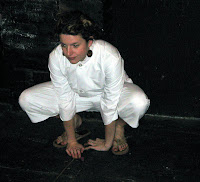 also a full-time yoga instructor. Do you think that your yoga and meditation practice influence your acting process?
Oh, that's that whole reason I was drawn to yoga as a "day job". I have always loved it. Like I said earlier, I am a very physical actor and yoga allows me to tap into every inch of my body. Allowing me to understand it, acknowledge my limits and how to push past them. Because of the practice, it's easier to mold my body into other people and get through a 2 hour play with lots of energy left. It's also an active meditation. Funny, I've recently noticed that my acting suffers if I don't keep up with my yoga practice. So much time is spent getting lost in a character, giving to your partners, that getting back to the mat allows me to breath, get out any and all anxiety about the current project and just let go. I teach and work at a studio called Yoga Now in the Gold Coast and they are super understanding of the actor's schedule, which is also nice (takes some stress off). A yoga studio constantly has traffic of people who are willing to open up about their lives, and I file away those cast of characters, and pull them out when needed in the rehearsal room.
Finally, for you, what is this play about?
This play is about the people of war. It's not a black and white subject; there are people, REAL human beings involved and this play allows their stories to be told. In college, I spent a semester in Japan, studying the psychological effects of the Atomic Bombs on Japanese society. We met dozens of survivors and their descendants, listening to their stories, walking on the soil where the bombs landed (though they were programed to go off before they hit the ground for maximum impact, but I digress), which made it almost tangible for us. That is what Hungry Ghosts does, allows the voices of war to be heard in a society that is detached from the day to day experience.
 also a full-time yoga instructor. Do you think that your yoga and meditation practice influence your acting process?
Oh, that's that whole reason I was drawn to yoga as a "day job". I have always loved it. Like I said earlier, I am a very physical actor and yoga allows me to tap into every inch of my body. Allowing me to understand it, acknowledge my limits and how to push past them. Because of the practice, it's easier to mold my body into other people and get through a 2 hour play with lots of energy left. It's also an active meditation. Funny, I've recently noticed that my acting suffers if I don't keep up with my yoga practice. So much time is spent getting lost in a character, giving to your partners, that getting back to the mat allows me to breath, get out any and all anxiety about the current project and just let go. I teach and work at a studio called Yoga Now in the Gold Coast and they are super understanding of the actor's schedule, which is also nice (takes some stress off). A yoga studio constantly has traffic of people who are willing to open up about their lives, and I file away those cast of characters, and pull them out when needed in the rehearsal room.
Finally, for you, what is this play about?
This play is about the people of war. It's not a black and white subject; there are people, REAL human beings involved and this play allows their stories to be told. In college, I spent a semester in Japan, studying the psychological effects of the Atomic Bombs on Japanese society. We met dozens of survivors and their descendants, listening to their stories, walking on the soil where the bombs landed (though they were programed to go off before they hit the ground for maximum impact, but I digress), which made it almost tangible for us. That is what Hungry Ghosts does, allows the voices of war to be heard in a society that is detached from the day to day experience.
Sunday, May 24, 2009
Kind Strangers & Delicious Haints
Karla Jennings, playwright of The Ruby Vector, came in from Georgia to see her play in LeapFest. Here she describes the experience.
When a reading goes well it's a rush, especially if you meet lots of theater people an d hit it off and leave feeling encouraged about your craft. Just being alone in a theater can flip on the writing synapses; invisible people surround you, living their lives in front of you, waiting for you to write them down and make them real.
The LeapFest trip was like that. All fronts were in high gear, from weather front to stage front. Even when I forgot my credit card and cash in my jogging socks back at the hotel, it was groovy; the cast and directors graciously fed me, beered me, and gave me a lift back. In the theater world, you can always depend on the kindness of strangers (except for the nut cases).
A staged reading serves two purposes: as a calling card for that play, so you invite dozens of directors, hoping that one or two will show up; and as an opportunity for the writer to examine her work as a thing in itself rather than a part of herself. This, one hopes, gives her the objectivity to improve it.
It's hard to shake a play out of your head, to be objective. The playwright's lack of perspective explains the slightly panicked look you might get when you ask someone to describe his or her play. Their inner voice is shrieking, "I've created a world, how can I sum it up when I'm swimming in its oceans? How can I encapsulate this small universe when I'm immersed in it?"
Ruby Vector already had three workshops, so at this point I was pretty sure its world was complete and any changes would bloat it into over-explanation or hammer dead the raw sparks that make it come alive. But at the first reading, before I came to town, someone noted that Act One felt like it ended in the penultimate scene, but then the stage lights go back up and you spend another damn five minutes watching the characters do their thing. Personally, I hate it when that happens. Even if I like the play, when I think intermission's here I'm eager to bolt to the loo or toddle in circles around the lobby or something. It makes me impatient when, like a Beethoven symphony, the ending just goes on and on.
So, we tossed the final Act One scene into the beginning of Act Two. That's better, I thought, but that's it. There's nothing left to improve.
However, shortly into the reading I attended, I thought, "What the hell's that line doing there? It's not necessary." Later, "Gee, that sounds beautiful but it doesn't move the plot, it's got to go." Then, "That line would rock if I rephrased it like this," then, "He's got to be stronger about his motivation here." On and on for five pages of notes, plus useful audience and directorial observations which, once they're pointed out, are kind of embarrassing in their obviousness.
So it's back to the drawing board for a (inshallah) final rewrite. Wish I could see the last performance -- it should be leaner, meaner, brighter, deeper. The LeapFest experience got me thinking of other plays I'm either writing or want to write -- potential scenes, lines of dialogue, plot developments. When I returned to my family my brain was buzzing with stuff I want to work on undistracted, alone. If I could choose between joining my girls and husband now or spending a week writing in a quiet mountain cabin, the choice would be obvious. I love my family, but inspiration fades fast. My peeps will be there, flopping around in my shoes, braiding my hair, and watching TV with the sound blasting, long after the invisible people who so deliciously haunt me have faded away.
When a reading goes well it's a rush, especially if you meet lots of theater people an
 d hit it off and leave feeling encouraged about your craft. Just being alone in a theater can flip on the writing synapses; invisible people surround you, living their lives in front of you, waiting for you to write them down and make them real.
The LeapFest trip was like that. All fronts were in high gear, from weather front to stage front. Even when I forgot my credit card and cash in my jogging socks back at the hotel, it was groovy; the cast and directors graciously fed me, beered me, and gave me a lift back. In the theater world, you can always depend on the kindness of strangers (except for the nut cases).
A staged reading serves two purposes: as a calling card for that play, so you invite dozens of directors, hoping that one or two will show up; and as an opportunity for the writer to examine her work as a thing in itself rather than a part of herself. This, one hopes, gives her the objectivity to improve it.
It's hard to shake a play out of your head, to be objective. The playwright's lack of perspective explains the slightly panicked look you might get when you ask someone to describe his or her play. Their inner voice is shrieking, "I've created a world, how can I sum it up when I'm swimming in its oceans? How can I encapsulate this small universe when I'm immersed in it?"
Ruby Vector already had three workshops, so at this point I was pretty sure its world was complete and any changes would bloat it into over-explanation or hammer dead the raw sparks that make it come alive. But at the first reading, before I came to town, someone noted that Act One felt like it ended in the penultimate scene, but then the stage lights go back up and you spend another damn five minutes watching the characters do their thing. Personally, I hate it when that happens. Even if I like the play, when I think intermission's here I'm eager to bolt to the loo or toddle in circles around the lobby or something. It makes me impatient when, like a Beethoven symphony, the ending just goes on and on.
So, we tossed the final Act One scene into the beginning of Act Two. That's better, I thought, but that's it. There's nothing left to improve.
However, shortly into the reading I attended, I thought, "What the hell's that line doing there? It's not necessary." Later, "Gee, that sounds beautiful but it doesn't move the plot, it's got to go." Then, "That line would rock if I rephrased it like this," then, "He's got to be stronger about his motivation here." On and on for five pages of notes, plus useful audience and directorial observations which, once they're pointed out, are kind of embarrassing in their obviousness.
So it's back to the drawing board for a (inshallah) final rewrite. Wish I could see the last performance -- it should be leaner, meaner, brighter, deeper. The LeapFest experience got me thinking of other plays I'm either writing or want to write -- potential scenes, lines of dialogue, plot developments. When I returned to my family my brain was buzzing with stuff I want to work on undistracted, alone. If I could choose between joining my girls and husband now or spending a week writing in a quiet mountain cabin, the choice would be obvious. I love my family, but inspiration fades fast. My peeps will be there, flopping around in my shoes, braiding my hair, and watching TV with the sound blasting, long after the invisible people who so deliciously haunt me have faded away.
Your final chance to see The Ruby Vector is May 30th at 2:00pm. Don't miss it or the other wonderful plays in LeapFest.
Subscribe to:
Posts (Atom)